Every meditation app, wellness book, and self-care post seems to suggest the same thing: wake up early, find a quiet spot, close your eyes, and sit still for at least 20 minutes.
If you're a mother, you probably read that and laughed.
The baby woke up three times last night. Someone needs breakfast. The toddler is already crying. The idea of 20 minutes of stillness before any of that begins sounds less like self-care and more like fiction.
So most moms either skip meditation entirely (because it feels impossible) or they try it, can't make it work in the ways they've been told it should, and quietly conclude they're just "not a meditation person." I want to push back on that. Because the actual research on meditation and mindfulness tells a very different story than the one the wellness industry tends to sell.
Why Standard Meditation Advice Fails Mothers
Traditional meditation guidance was largely developed in monastic settings, refined in clinical research on people with unstructured time, and popularized through a wellness culture that mostly pictures childless adults in silent apartments. It assumes four things most mothers don't have:
- Silence (or the reasonable expectation of it)
- Physical stillness without being climbed on
- A continuous 20-minute window
- A mind that can quiet down on request
There's also a visual problem. The way meditation gets marketed in the West — through yoga studios, wellness brands, and social media — has almost nothing to do with what meditation actually is or requires. You know the image: someone sitting in a perfect lotus pose, in a $250 yoga set, on a rock at the edge of a waterfall. That aesthetic tells a story about who meditation is for and what it demands. And for most mothers on a Tuesday morning, that story isn't theirs.
But meditation was never meant to be reserved for idyllic settings. You can wear pajamas. You can have your hair in a bun. You can sit on the couch with your back against the cushions. The practice is entirely inward — it has nothing to do with what you look like from the outside.
When those conditions aren't present, the advice stops working. And when you can't make it work, it's easy to conclude that you're the problem — when really, the instructions just weren't written for you.
The good news: those conditions aren't what makes meditation work.
What the Research Actually Says About Short Practices
A 2019 study in the journal Mindfulness found that even 5 to 13 minutes of daily meditation produced meaningful reductions in anxiety and mood disturbance in people who practiced consistently over 8 weeks. The key word there is consistently. Five minutes done every day outperformed 20 minutes done sporadically.
"Five minutes done every day outperforms 20 minutes done sporadically. Consistency is the variable that matters."
This is a meaningful shift in how to think about mom meditation. You don't need a long session. You need a reliable one.
The Difference Between Meditation and Hypnotherapy for Moms
I want to be honest with you about something, because I think it's relevant if you've tried meditation and found it genuinely hard.
Meditation asks you to observe your thoughts and return, again and again, to a focus point. Your breath. A mantra. A body sensation. For some people, that process is naturally settling. For others, especially mothers carrying high loads of anxiety or mental chatter, observing your thoughts can feel like trying to watch a fire without fanning it. The watching itself becomes another layer of effort.
Hypnotherapy works differently. As a clinical hypnotherapist, I work with women whose minds won't quiet in the way meditation requires. In a hypnotherapy session, the mind isn't asked to detach from its thoughts. It's guided somewhere specific. The thinking brain gets occupied, and underneath that, the body begins to shift.
A note from Ellen
In my clinical work, I see a consistent pattern: moms who've tried meditation and "failed" are often mothers with highly active, anxious minds. That's not a personality flaw. It's a nervous system that's been running on high alert for a long time. Hypnotherapy was designed for exactly that kind of mind. Where meditation builds awareness over time, hypnotherapy tends to create felt shifts faster — particularly around anxiety, reactivity, and sleep.
Both have real value — and you don't have to choose. Calm Mama was built because these two practices complement each other so well. It blends clinical hypnotherapy with guided meditations, both designed for real motherhood. The hypnotherapy reaches the subconscious layer where deeper patterns live; the meditations build the daily practice that keeps your nervous system regulated over time. Together, they give your mind the full range of what it needs. If meditation has felt like pushing against something, try having both available and letting yourself use whichever one actually fits the day you're having.
Where Meditation Actually Fits in Real Motherhood
The moment I stopped trying to create perfect conditions for meditation and started working with the conditions I actually had, everything changed. Here's what that looks like in practice.
Before anything else: if you can carve out even a few minutes of quiet before your family wakes up, I really want to encourage that. Put your phone away the night before. Try to go to sleep as early as you can, knowing you'll probably have some broken sleep anyway. And when your little one is in a more settled rhythm — sleeping long enough that you're actually getting some rest too — try giving yourself a small window that's yours. Sit somewhere peaceful. No phone. Maybe a coffee or tea. Just a few minutes to move inward before the noise starts. That morning window, when it's available, sets the tone for the whole day in a way nothing else can quite match. And if it's just not the season you're in right now, scale it back. It doesn't have to be 20 minutes. It doesn't even have to be five. Three minutes of slow, deep, intentional breathing counts.
In the car. Two to three minutes in a parked car before you walk into the house is one of the most genuinely accessible moments in a mother's day. You're already sitting. The children aren't with you. Put your phone face down and just breathe. A short guided audio works especially well here.
In the bathroom. Yes, really. A two-minute body scan in the only room in the house with a lock is still a body scan. Your nervous system doesn't require an Instagram-worthy setting.
In bed, before they wake up. Five minutes with headphones before you hear the first small feet in the hallway. This one is worth setting a five-minute earlier alarm for. The return is disproportionate to the cost.
At night, after bedtime. Ten intentional minutes after the children are asleep, before your phone pulls you back into stimulation. This is the window most mothers waste, and it's one of the highest-value moments of the day for nervous system recovery.
What all of these have in common is non-attachment to conditions. We don't need silence. We just need to stop requiring it. When you treat sounds as no problem, they become no problem — and you find you can practice in just about any setting. I've done it on public transit, in the car on the way to an airport, and yes, in a fitting room.
What about being climbed on? Ideally not — but I've had more than a few sessions with my daughter sitting in my lap. Is it the deepest practice? No. But she learns something important in those moments too. And what matters most is that I showed up. An imperfect meditation done consistently beats a perfect one you never get around to.
Try this today
The 5-Minute Morning Reset for Moms
Do this before you pick up your phone. Before you speak to anyone. Even 4 minutes counts.
Settle your body (60 seconds). Sit or lie where you are. Feel the weight of your body against whatever surface is holding you. Take three slow breaths, exhaling longer than you inhale. You don't have to empty your mind. Just let your body be still.
Name what's already here (60 seconds). Without judgment, notice what's in your body right now. Tension in your shoulders? Tightness in your chest? Tiredness? Just name it silently. Naming a sensation reduces its intensity — this is well-established in the neuroscience of affect labeling.
Set a single intention (60 seconds). One word or one sentence for how you want to show up today. "Patient." "Present." "Soft." Say it twice. Let it land somewhere below your thoughts.
Three grounding breaths to close (60 seconds). Breathe in for 4 counts, hold for 2, out for 6. Repeat three times. This activates your parasympathetic nervous system — your body's rest-and-recover mode. Then open your eyes.
That's it. Four minutes. You can do this on your phone timer with your eyes closed. You don't need a specific space or permission from anyone.
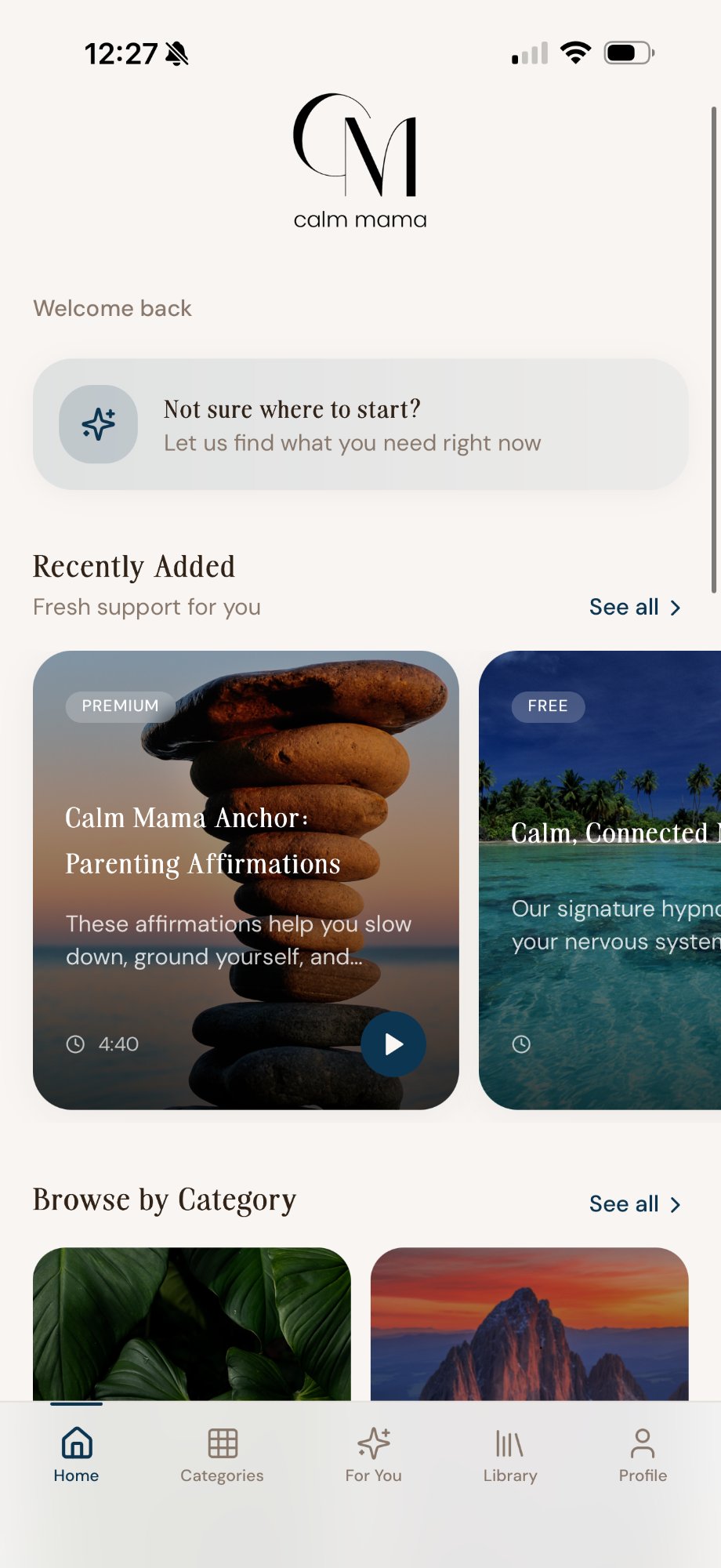
If you'd rather be guided, there's a short audio in the Calm Mama app called the Rooted and Ready Morning Reset — it's free. Log in, scroll to the free content, and you'll find it there. Under 7 minutes, plays in the background, and you don't even have to close your eyes.
Your mind deserves something that actually works for it.
Calm Mama's app has short clinical hypnotherapy sessions and guided meditations built for the reality of motherhood — 3 minutes or 30, available at 2am, in the car, or on a Tuesday when everything is too much. Start free, no credit card needed.
Start FreeHow to Build a Habit That Actually Sticks
The research on habit formation is pretty consistent here. Small, specific, and anchored to something existing. That means:
- Attach your practice to something you already do every single day (making coffee, brushing teeth, sitting in the parked car)
- Keep the barrier to entry near zero. A single guided audio you already have downloaded. Headphones already on your nightstand.
- Decide the duration in advance and keep it modest. Three minutes is not a failure. Three minutes done daily for two months is a genuine practice.
- When you miss a day, miss one day. Missing two in a row is where habits dissolve, according to research by BJ Fogg at Stanford's Behavior Design Lab. One miss is just Tuesday.
The mothers I work with clinically who see the most change are rarely the ones doing the longest sessions. They're the ones who do something small, every day, with consistency that a busy life can actually hold.
When Mindfulness for Mothers Isn't Enough on Its Own
Meditation and mindfulness are genuinely useful. I believe that and I recommend them. But there are situations where they reach the edges of what they can do.
If you're dealing with postpartum anxiety that has a physical grip on you, regular meditation may not move it fast enough. If you have old patterns of hypervigilance or perfectionism that run deeper than conscious awareness, mindfulness can help you observe them but may not shift them at the root. If every time you try to sit still, your mind races through the to-do list and you end up more anxious than when you started, you may need a different tool alongside it.
This is where clinical hypnotherapy earns its place. It reaches the subconscious layer where those patterns live. It works with the part of your brain that responds before logic arrives. And for a significant number of mothers, it produces a felt sense of relief that years of trying to think their way calmer couldn't.
The sessions inside Calm Mama are designed exactly for this. Short enough to fit in real motherhood, clinical enough to actually work, and built by someone who understands this terrain from the inside.
The Bottom Line
You don't need 20 minutes. You don't need silence. You don't need a meditation cushion or a perfectly calm mind to start with.
You need something realistic enough to do today, consistent enough to matter over time, and honest enough to acknowledge that some minds need more than sitting with their thoughts.
Start with five minutes. Start in your car. Start with a guided audio if sitting in silence feels like a battle. Start with the morning reset practice above. And if meditation continues to feel like pushing against something, give hypnotherapy an honest try. Your nervous system deserves something that works for the way it actually is.
Common questions
Frequently Asked Questions
This article is for informational purposes only and does not constitute medical advice. If you are experiencing anxiety or mental health difficulties during or after pregnancy, please speak with your doctor or a qualified healthcare provider.