This is postpartum anxiety — and it affects up to one in four new mothers. It is more common than postpartum depression, significantly under-diagnosed, and one of the least discussed aspects of the postpartum experience. If this sounds like you, you are not falling apart. Your nervous system is doing exactly what years of evolution designed it to do — only right now, it cannot tell the difference between a genuine threat and a sleeping baby.
The question I'm asked most often is this: can hypnotherapy actually help with postpartum anxiety? The short answer is yes. The longer answer is worth understanding — because when you see why it works, it changes everything.
What Is Postpartum Anxiety — And Why Is It So Often Missed?
Postpartum anxiety is not simply "worrying a lot after having a baby." It is a clinical condition involving the dysregulation of your nervous system's threat-response — your fight-or-flight mechanism — in the weeks and months following birth.
Unlike postpartum depression, which tends to present as low mood, withdrawal, and flatness, postpartum anxiety is characterized by hyperactivity. Racing thoughts. Worst-case-scenario thinking. Relentless mental loops about your baby's safety. Physical symptoms like a racing heart, shortness of breath, nausea, and muscle tension. An inability to rest even when rest is finally available.
It can also look quieter than you might expect. You rush through moments with your baby because your body only knows tension, not ease. You overthink simple decisions — the nap schedule, the feeding choice, the carrier brand — because your brain is permanently scanning for what could go wrong. You snap at small things and then spiral in guilt minutes later. From the outside, you look fine. From the inside, you are holding everything together with white knuckles.
It is missed so often because, frankly, a lot of this gets normalized. New motherhood is exhausting and frightening — of course you're anxious, people say. But there is a significant difference between normal adjustment and a nervous system that is stuck in a permanent state of red alert. Research suggests postpartum anxiety affects somewhere between 17% and 42% of new mothers depending on the screening criteria used, making it one of the most prevalent perinatal mental health conditions worldwide.
Why Postpartum Anxiety Often Hits the Most Prepared Moms Hardest
Here is something worth sitting with: the mothers who tend to struggle most with postpartum anxiety are often the most prepared. Organized, capable, high-functioning. They had the nursery sorted, the research done, the birth plan written. And then the baby arrived, and they discovered that none of it — not a single sleep schedule or carefully chosen gadget — could give them back the one thing postpartum anxiety is really about: control.
Postpartum is one of the very few seasons of life in which control genuinely disappears. You can do everything right and still struggle with feeding. You can be an excellent professional, a prepared partner, an organized human being — and still find yourself completely disarmed by the unpredictability of a newborn.
If you have spent years building your sense of safety around being capable and prepared, postpartum doesn't just challenge your routine. It challenges the coping strategy you have relied on your whole life. The hypervigilance, the planning, the relentless problem-solving — these are the very traits you've been praised for. But in a season where uncertainty is the only constant, those same strengths can keep you stuck. Your nervous system doesn't know how to stand down. It only knows how to scan for the next thing to fix.
Why Postpartum Anxiety Is a Nervous System Problem
To understand why hypnotherapy works for postpartum anxiety, you first need to understand what is actually happening in your body.
During pregnancy and in the weeks following birth, your brain undergoes a remarkable restructuring — a process researchers call matrescence. Hormonal changes, sleep deprivation, and the biological imperative to protect a vulnerable infant all conspire to heighten your nervous system's sensitivity to threat. In evolutionary terms, this makes complete sense. A mother who wasn't hypervigilant to danger wouldn't have kept her infant alive.
The problem is that your nervous system doesn't know that the saber-toothed tiger is no longer relevant. It has been wired for vigilance, and it is very, very good at its job. Every unpredicted sound, every moment you can't see the baby, every deviation from what you expect — these all register as potential threats. The anxiety you experience isn't irrational. It's your nervous system doing its job too well, without an off switch.
"The traits that have always made you strong — the preparation, the vigilance, the drive to get it right — can also be the things keeping you stuck. Postpartum anxiety isn't a character flaw. It's a nervous system that never learned it was allowed to rest."
What Is Clinical Hypnotherapy — and How Does It Work?
Let's clear something up immediately: clinical hypnotherapy is not what you've seen on stage. There is no swinging pocket watch. You are not unconscious, out of control, or doing anything you don't want to do. Clinical hypnotherapy is a modality in which a practitioner guides you into a state of deep, focused relaxation. In this state, your conscious, analytical mind quiets, and your subconscious becomes highly receptive to new patterns and suggestions.
This is significant because anxiety is not a conscious problem. You cannot think your way out of postpartum anxiety any more than you can consciously lower your heart rate during a panic attack. The anxiety lives in the subconscious — in the automatic threat-response patterns of your nervous system. That's exactly where hypnotherapy works.
Through clinical hypnotherapy, the subconscious can be gently, systematically guided toward new patterns: safety instead of threat, calm instead of hypervigilance, regulation instead of reactivity. It is not about suppressing the anxiety or pretending it isn't there. It is about retraining the system that generates it.
What Does the Research Say?
The evidence base for hypnotherapy in perinatal mental health is growing, though it remains an emerging field — something I think is worth being transparent about.
A study published in PubMed found that women who received hypnosis interventions during pregnancy had significantly lower postpartum anxiety and depressive symptoms at two months postpartum. A 2022 systematic review examining the psychological impact of hypnosis in pregnancy and childbirth found broadly positive effects on anxiety, fear, and emotional confidence. And a 2025 study published in Frontiers in Medicine identified group hypnotherapy as a promising transdiagnostic intervention for emotional disorders in the perinatal population.
Research note
More rigorous randomized controlled trials are underway. The clinical picture is consistent: hypnotherapy, practiced correctly and delivered by a qualified clinical hypnotherapist, can meaningfully reduce postpartum anxiety. It is not a miracle cure — it is a clinically grounded tool that works on the same nervous system mechanisms that generate the anxiety in the first place.
How Clinical Hypnotherapy Addresses Postpartum Anxiety Differently
Other interventions for postpartum anxiety are genuinely valuable. CBT helps you challenge anxious thoughts at the conscious level. Medication can provide essential stabilization. Mindfulness and breathwork offer real-time nervous system support. All of these have their place.
What makes clinical hypnotherapy distinct is that it operates below the level of conscious thought — directly within the subconscious where the anxiety pattern lives. It does not ask you to think differently. It works with the part of your mind that has been running the anxiety program without your permission, and it begins to change the code.
For postpartum anxiety specifically, this matters. When you are exhausted, hormonally fluctuating, and sleep-deprived, the capacity for effortful conscious work — the kind required by traditional talk therapy or CBT exercises — is limited. Hypnotherapy meets you where you are. You lie down, you close your eyes, and you let the session do what it was designed to do.
Is Hypnotherapy Safe Alongside Therapy or Medication?
Entirely. Clinical hypnotherapy is non-pharmacological — it involves nothing that interacts with medication or breastfeeding. It is specifically designed to complement professional mental health support, not replace it.
If you are currently working with a therapist, a psychiatrist, or your doctor to manage postpartum anxiety, clinical hypnotherapy can sit alongside that care comfortably. Many therapists actively recommend it for their postpartum clients. I designed Calm Mama with the explicit intention that it should be something your mental health team would approve of — a complement, not a workaround.
Ready to try something that works differently?
The Radiant Mother Method™ is Calm Mama's 28-day clinical hypnotherapy program — designed specifically for postpartum anxiety, nervous system dysregulation, and the profound psychological shift of early motherhood. A standalone program: one-time purchase, instant access.
Explore The Radiant Mother Method™How Calm Mama Supports Postpartum Anxiety
Whether you are in the thick of early postpartum, months into motherhood and still not feeling like yourself, or simply looking for more consistent nervous system support, Calm Mama has a way in for you.
The Radiant Mother Method™ is our flagship 28-day clinical hypnotherapy program built specifically for the postpartum period. It addresses anxiety, nervous system dysregulation, postpartum rage, sleep challenges, maternal identity, and the profound psychological shift of becoming a mother — systematically, session by session.
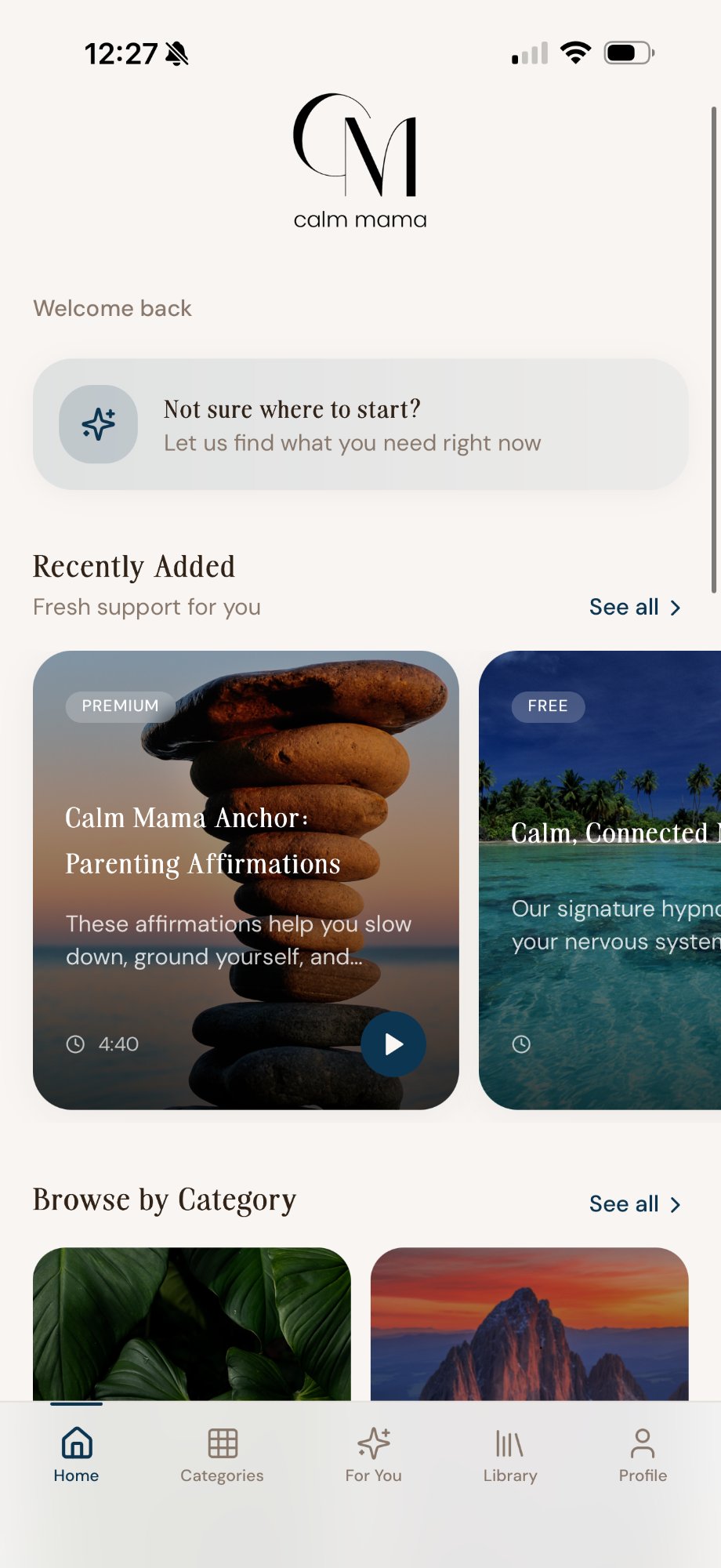
If you're not ready for a full program, that's okay too. Calm Mama has an entire library of individual audio sessions designed for this season of life — a dedicated postpartum section, an anxiety category, and an emotional healing category — so you can drop into exactly what you need, exactly when you need it.
Not sure where to start? Our AI audio picker takes the guesswork out entirely. Tell it what's going on, what you're feeling, what's been hard — and it will recommend the best sessions for you.
You don't need a full hour. You don't need quiet. You need five minutes, a pair of headphones, and a nervous system that is ready to learn something new.
Common questions
Frequently Asked Questions
This article is for informational purposes only and does not constitute medical advice. If you are experiencing postpartum mental health difficulties, please speak with your doctor or a qualified healthcare provider.